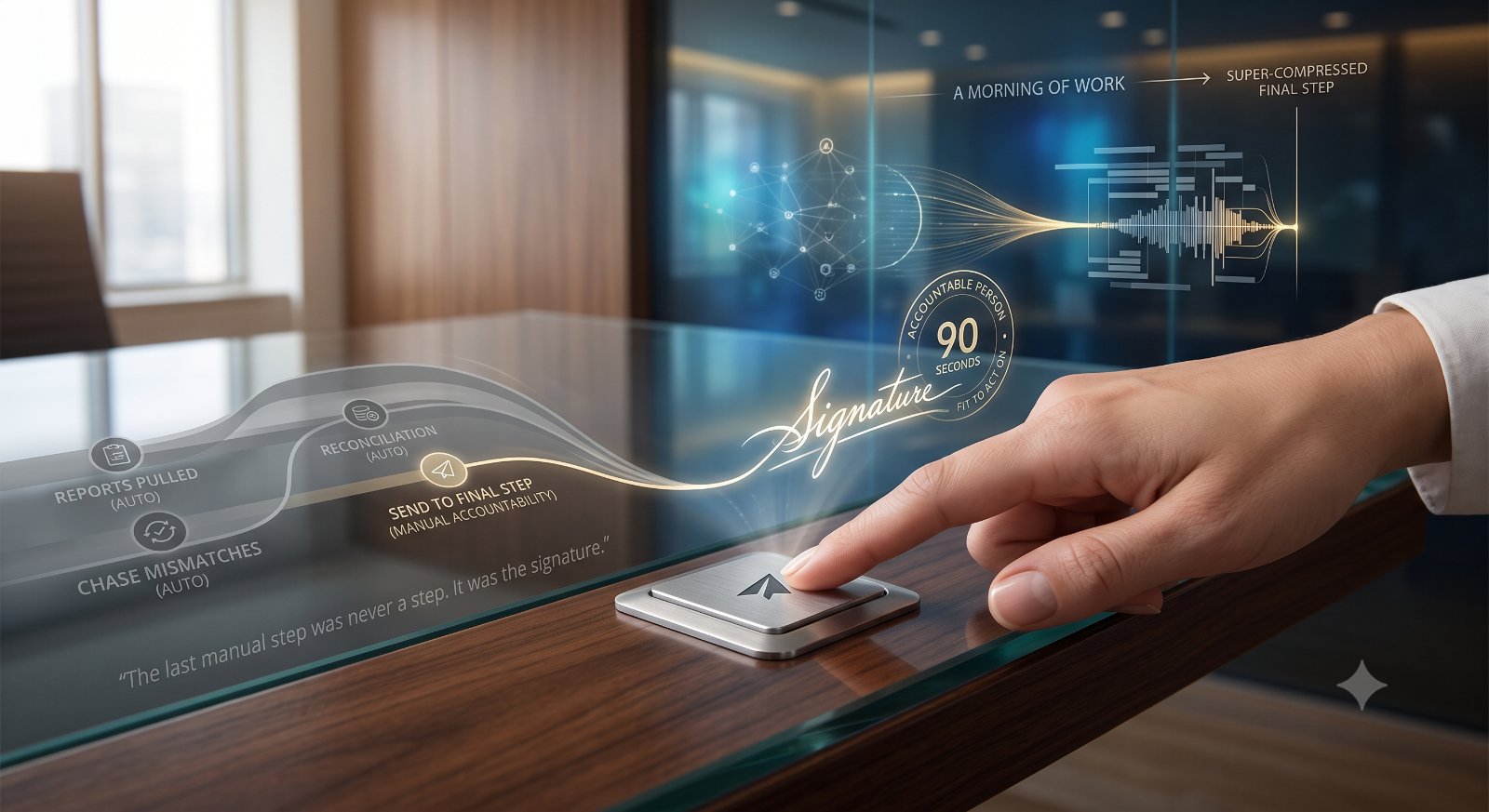
Every Friday for two years I ran the same closing routine: pull three reports, reconcile them, chase the mismatches, post the summary. It took a morning. Being an automation developer with a sense of irony, I did to myself what I do to everyone else — I started removing steps.
The report pulls went first; a scheduled job did them before I woke up. Then the reconciliation, which was just rules wearing a trench coat. Then the chasing, once I admitted that a politely worded automatic reminder outperforms me on both persistence and tone. Each Friday the routine got shorter, and each Friday I felt the same small vertigo: this piece, too, was never really mine.
After a few months, one step remained. The system assembled everything and waited for me to look at it and press send. Colleagues asked why I didn’t automate that too — the machine was, by then, more consistent than I was. Strictly speaking they were right, and I did it anyway: I kept the button.
The last manual step was never a step. It was the signature.
Because the last step was never a step. It was the signature. Pressing send meant a person had judged the numbers fit to act on, and everyone downstream behaved differently because a person had. The morning of work compressed into ninety seconds, but those ninety seconds carried the entire weight of the original job: I am accountable for this being right.
This is what I now believe automation actually does when it goes well. It does not remove people from processes; it distils their involvement down to the parts that were always the point — judgment, accountability, the willingness to put your name on an outcome. Everything else was wrapping.
It also changed what those ninety seconds felt like. When the reconciliation took a morning, I checked the numbers with a tired mind and a queue behind me. Now I arrive at the button fresh, with the machine’s full working laid out for inspection, and I catch things the old, busier me would have waved through. Less time on the task, more attention on the decision — that trade is the entire promise of this field, stated small.
So when someone asks me what will be left for people once the machines can do the steps, I think about Friday mornings. The steps were never the job. The job was the send button, and we should design every automated process so that somebody, visibly and meaningfully, still owns it.