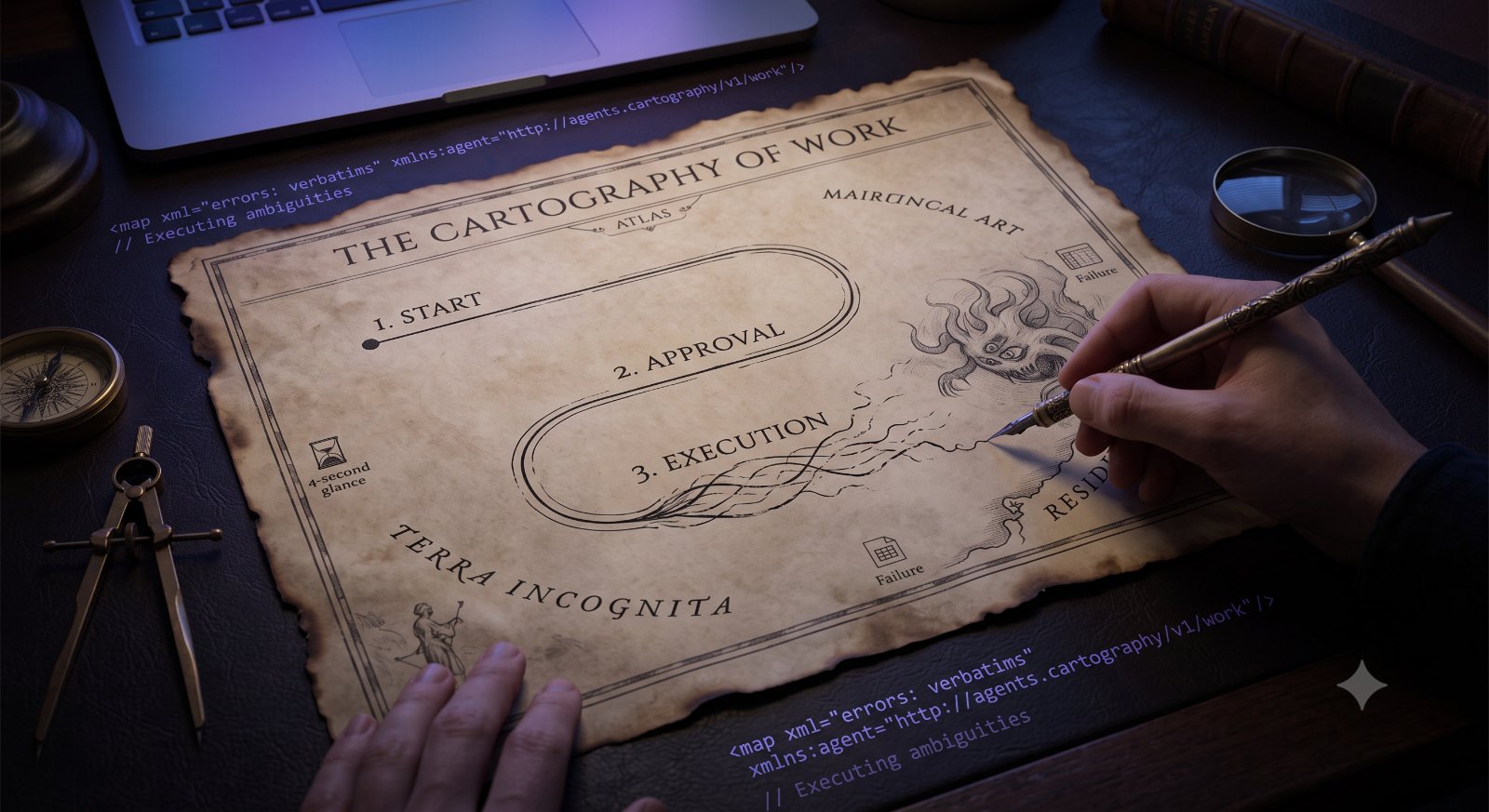
The first process map I ever drew was wrong, and it was wrong in a way I have since learned to expect. I was a new consultant with a fresh licence for an expensive diagramming tool, sitting across from a payroll specialist who had run the same monthly process for eleven years. I asked her to walk me through it. She did, fluently, and I drew what she said: twelve steps, three decision points, one loop. It was a beautiful diagram. It was also a work of fiction, and neither of us knew it.
The fiction revealed itself three weeks later, when the robot we built from my map met the real world. It turned out there was a thirteenth step she had not mentioned because she did not experience it as a step: a glance at a shared mailbox to see whether a certain kind of correction had come in from the union office. The glance took her four seconds. It took us two workshops to discover, one incident to appreciate, and a redesign to replace. Eleven years of practice had compressed an entire subprocess into something below the threshold of her own attention.
I have been drawing maps of work ever since, hundreds of them by now, and I have come to think of the discipline as cartography in a nearly literal sense. Not because the diagrams look like maps, but because they fail like maps. They flatten a living territory into something you can print. They privilege what the surveyor can see. They go out of date the moment they are published, and they are most dangerous precisely when they are most beautiful, because beauty is what convinces people to stop checking them against the ground.
Three versions of every process
Every process in every organisation exists in at least three versions, and the distance between them is where automation projects go to die. There is the process as designed: the official procedure, blessed by the quality system, often written years ago by someone who no longer works there. There is the process as described: what people tell you they do, which is usually the designed process with the embarrassing parts sanded off and the clever parts omitted out of modesty or self-protection. And there is the process as performed: the thing that actually happens, four seconds of mailbox-glancing included.
The gap between designed and performed is not a defect. It is the organisation’s immune system. Real work constantly encounters cases the design never imagined — the invoice in the wrong currency, the customer with two birth dates, the system that is down every third Tuesday. People bridge those gaps with judgment and workarounds, and the workarounds harden into practice, and practice becomes invisible even to the people performing it. An organisation where the performed process exactly matched the designed one would be an organisation where nobody was paying attention.
It is worth being honest about why the described process drifts from the performed one, because the reason is rarely dishonesty. People describe their work the way they were taught it ought to be done, partly out of professional pride and partly out of a well-founded instinct: process maps have a history of being used against the people mapped. If your workaround might read as a violation, you do not volunteer it to a consultant with a laptop. Which means the accuracy of my maps is downstream of something I cannot draw — whether the people in the room believe the map will be used to help them or to replace them. Trust is a surveying instrument. It is the most expensive one, and the only one that cannot be rented.
The workaround is not noise in the data. It is the most important signal on the map.
When I map a process now, the workarounds are what I hunt for first. Each one marks a place where the official design meets something it cannot handle, which means each one is either a requirement nobody wrote down or a risk nobody has priced. Automating the official process while ignoring the workarounds does not remove them; it removes the human who was quietly absorbing them, which is how you convert an invisible competence into a visible incident.
Surveying methods
So how do you survey the real territory? The workshop — a room, a whiteboard, the process’s stakeholders, and me with a marker — remains the standard instrument, and it earns its place. But a workshop measures the described process, not the performed one. People narrate their work as they understand it, in the order that makes narrative sense, at the resolution their attention can reach. The four-second glances do not attend workshops.
Observation gets you closer. Sitting beside someone for a day, watching the actual clicks, produces a different map than any interview — not because people lie, but because performance and description are stored in different parts of a person. The specialist who forgot the mailbox glance in the workshop performed it flawlessly in front of me, and when I pointed it out, she was genuinely surprised. “I suppose I do check that,” she said, in the tone of someone discovering they have been blinking all their life.
The newest instruments are the ones that watch the systems instead of the people. Process mining reconstructs the performed process from event logs, and it is the closest thing my field has to aerial photography: suddenly you see every path anyone has ever taken through the system, including the paths nobody would admit to and the loops nobody knew existed. The first time you show a process owner a mining visualisation of their own operation, there is always a silence. The official map has four paths. The photograph shows two hundred and forty.
But aerial photography has its own blindness: it only sees what touches the systems that log. The phone call that resolves the case, the hallway conversation that decides the exception, the glance at the mailbox — none of it leaves an event. The most honest survey combines all three instruments and treats their disagreements not as errors to reconcile but as findings in themselves. Where the story, the observation, and the logs diverge, something interesting is always living.
If you can ask only one question in a mapping interview, I can tell you which one earns its keep: “What do you do when it goes wrong?” The happy path is rehearsed and tells you little; people have described it to auditors, trainees, and their own managers for years. The failure path is where the real process lives — who they actually call, which rule they bend and by how much, where the unofficial spreadsheet is kept and why it exists. Ask about a normal Tuesday and you get the brochure. Ask about the worst Tuesday of the year and you get the territory, told with feeling.
The dangers of a good map
There is a book I press on every new process consultant: James C. Scott’s Seeing Like a State. It is nominally about scientific forestry, urban planning, and agrarian reform, and it is actually about what happens when powerful institutions mistake their simplified representations of a territory for the territory itself. Planners in the book redesign forests and cities around what their maps can express, and the parts of reality the maps could not express — the underbrush, the street life, the local knowledge — turn out to have been carrying the whole system.
Process work is miniature statecraft, and the failure mode transfers exactly. The moment a process map becomes the basis for an automation, a reorganisation, or a headcount model, it stops being a description and becomes an instrument of power. Whatever the map omits, the project will omit. Whatever the project omits, someone on the floor will absorb — silently, for a while, until they leave or break, at which point the underbrush burns.
A process map is a description until someone funds it. Then it is an instrument of power.
I have watched this happen at close range. A shared-services centre automated its document intake around a map that classified every incoming item into nine types, because nine types were what the workshop had produced. The performed process had roughly thirty, the long tail handled by two veterans through what their colleagues called feel. The automation routed the nine types beautifully and shredded the feel. Within a year, the veterans’ successors had no way to learn what the veterans had known, because the cases that taught it no longer reached a human. The map did not just miss the territory; it paved it.
There is a subtler danger still, which is that maps do not merely describe territories; they teach territories to resemble them. Once a process is mapped and measured, the measured path becomes the career-safe path. People stop exercising the judgment that lived in the unmapped corners, because judgment is now indistinguishable from deviation on somebody’s dashboard. The map becomes true over time not because it was accurate but because it was enforced — and an organisation can lose a competence this way without a single person deciding to discard it. Cartographers call the map changing the ground a success. In process work, it deserves a more careful name.
The lesson is not that we should refuse to simplify. Simplification is the entire point of a map; a map at one-to-one scale is just a second territory to get lost in. The lesson is that the mapmaker owes the territory an account of what was left out. Every process map I deliver now ships with a companion document I call the residue: the exceptions we chose not to model, the knowledge we could not elicit, the volumes we estimated instead of measured. The residue is the most honest page in the deliverable, and I have learned to judge automation vendors by how quickly they ask for it.
When the reader of the map is a machine
Everything above was true before large language models, but the stakes have changed shape. For all of my career, a process map was read by humans and executed by humans or by rigid scripts. The map could afford ambiguity because a person would interpret it. Now we are entering a period where the reader of the map is increasingly a machine — an agent that takes the documented procedure as its instructions and improvises the gaps.
This inverts a very old relationship. The performed process used to be the real one, with the documentation trailing behind it like a shadow. But an agent onboarded from your documentation will perform the documented process, gaps and fictions included. Whatever your quality system says becomes, for the first time, operationally true. Organisations are about to discover exactly how fictional their official procedures are, in production, at machine speed.
I find this bracing rather than terrifying, because it finally gives documentation a real feedback loop. When the map is source code, errors in the map become bugs you can see, log, and fix, instead of frictions a human silently absorbs. The mailbox glance, once discovered, becomes an explicit step with an explicit owner. The residue document stops being an appendix and becomes a backlog. Cartography stops being an annual ritual performed for auditors and becomes something closer to gardening — continuous, humble, and observed.
It also means process documentation is about to acquire a second audience, and the two audiences want different things. Humans want maps that build understanding: context, intent, the why behind the rule, pitched at the resolution a colleague can absorb. Machines want maps that compile: unambiguous conditions, explicit boundaries, every implicit “obviously” spelled out. Writing for both at once is a genuinely new literary form, and I suspect it becomes one of the defining crafts of the next decade of operations work — part technical writing, part legislation, part choreography. The organisations that treat it as an afterthought will discover that their agents are executing the ambiguities verbatim.
But the transition period is going to be littered with paved underbrush. The organisations that hand their official process maps to agents without first surveying the performed reality are going to automate their own fictions, and the people who used to bridge the gaps will be gone before anyone understands what they were carrying. If you do one thing before deploying agents into a process, do this: sit with the people who run it today, watch their hands, and write down every four-second glance. It is the cheapest risk reduction available in this entire field.
The mapmaker’s oath
Cartographers of the age of exploration had a habit I have come to admire: they drew their ignorance. Where the survey ended, the map said so — terra incognita, here the knowledge stops. The monsters they sketched in the blank spaces were, in their way, a form of honesty: warnings that the mapmaker’s confidence did not extend here.
Modern process tooling has no symbol for terra incognita. Every diagram exported from every tool looks equally authoritative, equally complete, equally paid-for. The swimlanes do not blush. Nothing in the notation distinguishes the step we observed two hundred times from the step a manager guessed at in a hurry, and so the reader — human or machine — inherits a false uniformity of confidence.
So I have started drawing my monsters back in. Steps we never observed get marked. Volumes we estimated get ranges instead of numbers. Decision rules elicited from a single interview carry the name of the interview, so the future reader knows exactly how deep that particular survey went. It looks less polished. Clients occasionally ask whether the marks can be removed for the steering-group version, and I have learned to say no politely, because the marks are the deliverable. The polish is the fiction.
And because territories move, the survey has to become a rhythm rather than a rite. The traditional cadence — map the process once, laminate it, revisit at the next reorganisation — was always a polite fiction, but it was a survivable one when humans interpreted the maps. It is not survivable when machines execute them. The performed process shifts weekly: a supplier changes a portal, a colleague invents a better workaround, a regulation adds a field. Somebody has to notice, and re-mark, and re-publish, continuously. The mapmaker’s real deliverable was never the map. It was the practice of keeping one honest.
The work of mapping work is not going away. If anything, the next decade will need more of it, done more honestly, than my field has ever managed — because for the first time the maps will be executed exactly as drawn, by readers who cannot smell a fiction. The territory has always forgiven our maps their little lies. The engines will not.
Draw the glance. Mark the monsters. And never let anyone fund the beautiful version.