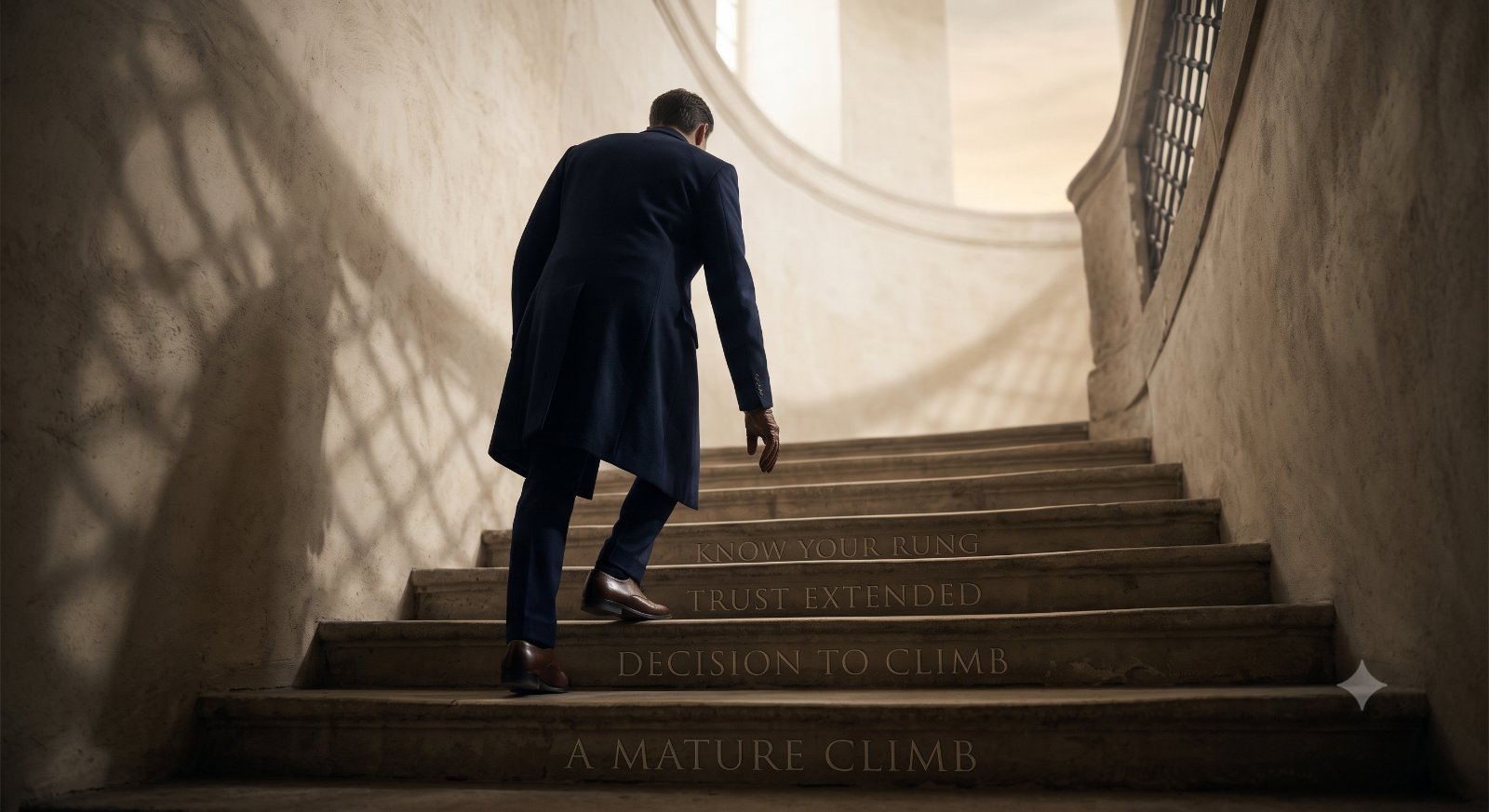
The word singularity conjures a cliff: an event, a date, a before and an after. Decades of science fiction have trained us to scan the horizon for the moment the machines wake up. I have stopped finding that picture useful. From where I work — inside the organisations actually adopting these systems — nothing looks like a cliff. It looks like a ladder, climbed one rung at a time, with each rung feeling almost mundane by the time we stand on it.
I started sketching this ladder for my own sanity, because clients kept asking one question — how far will this go? — and every available answer was either a shrug or a prophecy. A ladder is neither. It does not tell you when you will reach the top or whether the top exists. It tells you what changes at each height, which is the thing you can actually plan for.
The rungs
Rung one is the tool. Software does exactly what it is told, when it is told, the same way every time. A spreadsheet, a script, a classic robot. The human holds the whole task in their head; the tool holds none of it. Almost everything digital in your organisation lives here, and there is nothing primitive about that — civilisation runs on rung one.
Rung two is the assistant. The machine now proposes and the human disposes: it drafts the email, suggests the diagnosis code, autocompletes the paragraph. Nothing ships without a human hand on it, but the centre of gravity has already shifted — the human has moved from author to editor, and the quality of their work now depends on the quality of their scepticism. Most knowledge work crossed onto this rung in the last few years, many workers without noticing the step.
Rung three is the colleague. The machine holds a goal, works over minutes or hours, uses tools of its own, and comes back with finished work and an account of how it got there. The human relationship changes from editing to delegation-with-review, the way you supervise a capable junior. This is the rung being built right now, and it is the first one that forces organisational questions — scope, authority, escalation — rather than merely technical ones.
Rung four is the delegate. The machine owns an outcome continuously: monitor this, keep that within bounds, handle what arrives. Humans set policy and review samples; the day-to-day flow no longer passes through anyone’s hands. We already trust narrow systems this far — spam filters, fraud engines, grid balancers — but doing it for open-ended knowledge work is a different order of trust, and we are only at its edge.
Rung five, the horizon rung, is the institution: machine systems participating in setting goals, not just meeting them — allocating budgets, designing processes, negotiating with other institutions’ machines. I am not certain we should build this rung, and I am certain we should not back onto it accidentally through a thousand unexamined procurement decisions. Horizon rungs deserve to be climbed facing forward.
No rung is reached by technology alone. Every rung is reached by technology plus a decision to trust it.
Why rung-counting matters
The first thing the ladder buys you is honesty about location. In every organisation I visit, different processes stand on different rungs — the chatbot is on two, the credit decisioning quietly on four — and most of the anxiety in the building comes from arguing about the ladder as if it were one thing. Map your processes to rungs and the fog condenses into a list. Lists can be managed.
The second thing it buys you is the insight that climbing is a choice. No rung is reached by technology alone; every rung is reached by technology plus a decision to trust it with something. That decision has owners, preconditions, and reversibility, which means the sane climbing protocol is the mountaineer’s: move one limb at a time, test the hold, keep a way back. Concretely — do not move a process up a rung until you can measure its performance on the current one, and never climb two rungs in one project. The organisations in trouble are, almost without exception, the ones that leapt from tool to delegate because a vendor’s demo made rung four look adjacent.
Rungs also travel downward, and a mature organisation climbs in both directions. When the fraud pattern shifts, you pull the credit engine back to assistant mode and put humans on the fresh cases until the model relearns the terrain. When an agent’s error account starts smelling wrong, you narrow its authority while you investigate. Descending a rung is not failure; it is what having a ladder is for. The systems I distrust most are the ones deployed with no way down — trust extended irreversibly is not trust at all, it is surrender with better branding.
The third thing the ladder dissolves is the cliff itself. If a singularity comes, I increasingly suspect it will not feel like an event at all. It will feel like a Tuesday on which we notice, mildly surprised, how many processes stand on high rungs — the way you notice one day that nobody you know prints boarding passes anymore. The discontinuity, if that word even applies, is an accumulation of small consents.
And that is, quietly, the most optimistic claim I know how to make about this technology. Cliffs happen to you; ladders are climbed. Every rung is a place where people can pause, measure, argue, regulate, and occasionally refuse. The future arrives one act of extended trust at a time — which means the future is, to a degree the prophets on both sides keep denying, still being decided by the people extending it. Know your rung. Climb on purpose.